Ingredients, reviews, and professional insight for NZ beauty
Youngblood Mineral Cosmetics has been a quiet fixture in NZ salon treatment rooms for years — recommended by aestheticians to clients whose skin has just been resurfaced, peeled, or lasered into temporary vulnerability. The brand built its reputation not on influencer hauls or department store counters but on the specific promise that its formulations would not make compromised skin worse. That is a narrower claim than most beauty brands are willing to make, and it is worth examining whether the products deliver on it.
Mineral cosmetics get their colour from ground-up rocks and earth pigments rather than synthetic dyes. The base palette comes from three workhorses: zinc oxide for white and opacity, titanium dioxide for coverage and natural UV protection, and iron oxides for every shade from pale beige through deep brown. Mica adds light-reflecting shimmer where needed. These are not exotic ingredients — they have been used in cosmetics for centuries, long before anyone thought to market them as “clean”.
The appeal for reactive skin is partly about what mineral formulations leave out. No synthetic fragrance, no FD&C dyes, no parabens in a pure mineral formula. But the more relevant point is how mineral pigments behave on skin. They sit on the surface rather than being absorbed, which means less interaction with the lipid barrier. For skin that is already compromised — whether from a chemical peel, a bout of dermatitis, or just chronic sensitivity — that physical barrier approach causes fewer problems than ingredients designed to penetrate.
The trade-off is performance. Mineral pigments do not blend the way silicone-based foundations do. Coverage builds differently. The finish tends toward matte unless the formulator works hard to counter it. These are solvable problems, but they explain why not every mineral product feels luxurious on application.
The word “mineral” on a cosmetics label means almost nothing in regulatory terms. There is no legal definition in New Zealand, Australia, or the United States that dictates what percentage of mineral-derived ingredients a product must contain to earn the label. A foundation could contain 15 percent iron oxides alongside dimethicone, cyclopentasiloxane, and a preservative system, and still call itself mineral.
This matters because the consumer browsing the shelf at a beauty counter is making assumptions the packaging encourages but the formulation does not guarantee. The distinction worth understanding is between loose mineral powders — which tend to be closer to a pure mineral formulation because they do not need liquid binders — and pressed or liquid mineral products, which require additional ingredients to hold their form. A pressed mineral powder needs binding agents, emollients, and sometimes silicones to keep the cake from crumbling. A liquid mineral foundation needs a delivery system that is, by definition, not purely mineral.
Youngblood positions itself at the stricter end of this spectrum, particularly in its loose powder range. But even Youngblood pressed products contain non-mineral ingredients by necessity. The honest question is not whether a product is “truly mineral” but whether the non-mineral ingredients are ones your skin can tolerate.
Youngblood exists because of a specific gap in the market that Pauline Youngblood identified in the late 1990s. Working in medical aesthetics in the United States, she saw patients leaving dermatology clinics and plastic surgery practices with no makeup options that would not irritate freshly treated skin. The cosmetics available at the time were formulated for healthy, intact skin — not skin recovering from a laser resurfacing or a deep chemical peel.
The brand launched through dermatologists and cosmetic surgeons, not through department stores or infomercials. That distribution choice shaped everything about the product line: the formulations prioritised ingredient safety over sensory luxury, the shade range targeted the patients walking through clinical doors, and the pricing reflected a professional channel that did not compete on volume. It was makeup recommended by the person who had just treated your skin, which carried a different kind of authority than a celebrity endorsement.
This is the fundamental difference between Youngblood and bareMinerals. Leslie Blodgett built bareMinerals as a consumer brand, famously selling it through QVC infomercials that emphasised how mineral makeup felt and looked. Youngblood built its reputation in treatment rooms where the priority was what would not cause a flare-up.
The three brands most often compared in the mineral category — bareMinerals, Jane Iredale, and Youngblood — occupy distinct positions despite the shared label. bareMinerals is the accessible entry point. It is widely stocked, including at Sephora NZ, and its formulations have evolved to include products that are mineral in name but increasingly conventional in composition. The Original Loose Powder Foundation remains a competent mineral product, but much of the expanded range would not meet a strict mineral-only definition.
Jane Iredale shares Youngblood’s professional-channel roots and similar price positioning. The key formulation difference is Jane Iredale’s emphasis on botanical extracts and antioxidants alongside mineral pigments — the brand leans harder into skincare-meets-makeup territory. Its PurePressed Base is popular in NZ salons and offers good coverage with a slightly more luminous finish than Youngblood equivalents.
Youngblood keeps the tightest ingredient lists of the three. Fewer botanicals than Jane Iredale, fewer conventional cosmetic ingredients than bareMinerals. The trade-off is a narrower shade range and a learning curve on application — particularly with the loose minerals, which require technique to avoid a powdery finish. For someone choosing between the three, the decision often comes down to whether you prioritise ingredient minimalism (Youngblood), skincare benefits (Jane Iredale), or accessibility and shade range (bareMinerals).
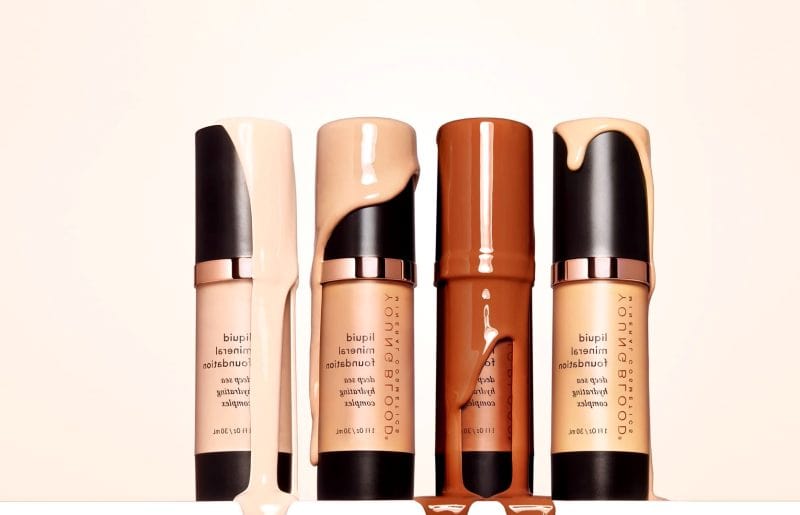
The Liquid Mineral Foundation is the product that converted most NZ salon professionals to the brand. It delivers medium-to-full coverage without the heavy, occlusive feel of conventional liquid foundations, and it contains no chemical sunscreen, no synthetic fragrance, and no parabens. The finish is natural rather than dewy — it photographs well without flashback, which made it popular with makeup artists working in clinical before-and-after photography.
The Mineral Radiance Creme Powder Foundation bridges the gap between powder and cream formats. It applies like a cream but sets like a powder, which solves the blending problem that puts some people off loose minerals. Coverage is buildable, and it works well over sunscreen without pilling — a practical consideration in a country where daily SPF is non-negotiable.
The Pressed Mineral Rice Setting Powder is the sleeper product in the range. Rice powder absorbs oil without the chalky look that talc-based setting powders can leave on darker skin tones. It works across the shade range without leaving a white cast, which is harder to achieve than it sounds. The Mineral Primer, meanwhile, is competent but not exceptional — it does what a primer should without being the reason you buy into the brand. If budget is tight, this is the product to skip.
Skin that has just been through a professional treatment is not the same as skin that is generically “sensitive”. Post-procedure skin has a compromised barrier function — the outer layer has been deliberately disrupted by a peel, a laser, or an abrasive treatment. It is more permeable than usual, more prone to inflammation, and more reactive to ingredients that intact skin would tolerate without issue.
The cosmetics recommended for this window need to be non-comedogenic, free from common irritants, and ideally physical rather than chemical in their interaction with skin. This is where mineral formulations earn their clinical recommendation. Zinc oxide and titanium dioxide sit on the skin surface and provide coverage through physical opacity rather than chemical pigment absorption. They do not penetrate the compromised barrier the way liquid dye molecules can.
Youngblood formulations go further than just being mineral-based. They exclude fragrance, which is the most common cosmetic irritant. They avoid chemical sunscreen actives like oxybenzone and avobenzone, which can sting on broken skin. And they skip bismuth oxychloride — a mineral-derived ingredient that is technically natural but causes itching and irritation for a significant minority of users. That last omission is a deliberate differentiator from several competitors who include it for its silky application feel.
Mineral cosmetics are a less-irritating option, not a treatment. They will not heal sensitive skin, calm rosacea, or fix a damaged barrier. They are a better choice for skin that reacts to conventional cosmetics, but “better” is relative — some people with genuinely reactive skin will still have problems.
Bismuth oxychloride is the ingredient that catches the most people out in the broader mineral category. It gives mineral products a smooth, almost pearlescent application feel, and many brands use it precisely because it makes mineral makeup feel less powdery. But it causes a prickling, itching sensation for an estimated 10 to 15 percent of people with sensitive skin. Youngblood avoids it, which is to the brand’s credit, but some other mineral brands marketed as “sensitive skin friendly” include it prominently.
Mica is another potential issue, though less common. For most people it is completely inert, but a small percentage experience irritation, particularly with micronised mica particles. And titanium dioxide in nano form — used in some mineral sunscreens and cosmetics for a more transparent finish — remains a subject of ongoing research regarding skin penetration in compromised barriers.
The practical advice is straightforward: if you have genuinely reactive skin, patch test any new mineral product on the inside of your forearm for 48 hours before applying it to your face. And if your skin reactivity is persistent or worsening, a dermatologist is a better investment than a new foundation.
Youngblood reaches New Zealand consumers primarily through professional beauty salons and skin clinics. You will not find it at Farmers, Life Pharmacy, or the major retail chains. The brand is distributed through professional beauty supply channels, which means your local salon either stocks it or can order it, but walking into a shop and browsing the range is not how most people discover this brand.
This distribution model has practical implications. Shade matching typically happens during a consultation at a salon that carries the range, and that consultation is often bundled with a facial or skin assessment. If you already know your shade from a previous purchase, reordering is straightforward through your salon. If you are new to the brand and live outside Auckland, finding a stockist that carries the full range may take some effort.
Online purchasing is possible through various NZ beauty retailers, but shade accuracy from a screen is a gamble with any foundation — and more so with mineral products, where the finish differs from conventional cosmetics. The brand’s own website ships to New Zealand, though you will pay international shipping and potentially customs duty on orders over the threshold.
Youngblood sits at the premium end of the NZ cosmetics market. A Liquid Mineral Foundation runs approximately NZD 75 to 90 depending on the retailer and current exchange rate. Setting powders sit around NZD 55 to 70. The Mineral Radiance Creme Powder Foundation falls in the same bracket as the liquid. These are not impulse purchases.
For context, bareMinerals Original Loose Powder Foundation retails at Sephora NZ for roughly NZD 55 to 65 — about 20 to 30 percent less than Youngblood equivalents. Jane Iredale PurePressed Base sits closer to Youngblood pricing, typically NZD 70 to 85 through NZ salon stockists. The three brands form a clear pricing tier: bareMinerals at the accessible end, Youngblood and Jane Iredale at the professional premium.
Whether that premium is justified depends on why you are buying. If you need the tightest possible ingredient list for genuinely compromised skin, Youngblood’s formulation discipline has real value — you are paying for what is not in the product. If you want mineral cosmetics because you prefer the concept of cleaner makeup, bareMinerals delivers a competent product at a lower price. The salon-exclusive distribution also means Youngblood rarely goes on sale. No loyalty programme discounts, no Black Friday markdowns. The price you see is the price you pay.
The mineral cosmetics category launched on a genuine proposition: makeup made from ingredients that are less likely to irritate, less likely to clog pores, and more likely to let skin function normally underneath. In the early 2000s, that proposition was relatively honest. The brands that pioneered the space — bareMinerals, Jane Iredale, Youngblood — built products around mineral pigments and kept their ingredient lists short.
Two decades later, the category has been diluted by its own success. Mass-market brands saw the consumer appetite for “mineral” and “clean” and responded with products that carry the label without the formulation discipline. A foundation can contain mineral pigments alongside silicones, synthetic polymers, and chemical preservatives, and still market itself as mineral. The category has become as much a marketing position as a formulation standard.
Youngblood has stayed closer to its original formulation thesis than most of its competitors. The core products remain tightly formulated with short ingredient lists. But the brand is not immune to category pressure — product line extensions and colour cosmetics additions have introduced ingredients that the original purists might question. The honest assessment is that Youngblood remains one of the more credible mineral brands, but the category itself no longer means what it did when these brands started.
Youngblood works best as a specific solution rather than a general preference. If you are recovering from a professional skin treatment and your dermatologist or aesthetician recommends mineral cosmetics, Youngblood is one of the most defensible choices available in New Zealand. The ingredient lists are tight, the irritant exclusions are deliberate, and the brand’s clinical heritage is genuine rather than retrofitted.
For the broader consumer who has heard that mineral makeup is “better for your skin” and wants to make a switch, the calculus is different. Your skin may not need the level of ingredient restriction that Youngblood offers, and you may find that bareMinerals or a well-formulated conventional foundation serves you perfectly well at a lower price. The mineral label carries less meaning than it did 15 years ago, and choosing a foundation based on “mineral” alone is not a reliable shortcut to better skin outcomes.
Youngblood’s value lies precisely in its specificity. It is a specialist tool built for a defined purpose — and knowing whether you are the person who needs that tool is the most useful thing you can learn before spending the money.
A mineral foundation is not a moral choice or a health intervention. It is a formulation approach that uses different pigments and skips certain ingredients that cause problems for some skin. Youngblood does this more carefully than most of its competitors, and charges accordingly. The useful question is not whether mineral cosmetics are better in the abstract, but whether your skin has a specific reason to need what Youngblood offers — and whether you are willing to navigate the salon channel and the price tag to find out.