Ingredients, reviews, and professional insight for NZ beauty
Dermaplaning has been on salon menus here long enough that most women have a rough idea of what it is and a fairly wrong idea of what it does. The blade is real, the exfoliation is real, and on the right skin the result is good. What has grown up around it is a decade of claims the treatment cannot support, plus a piece of folklore about hair that will not lie down.

The skin is cleansed and then dried properly, which is the part people find odd. No oil, no gel, no slip of any kind – dry is the point, because the blade needs friction to lift anything other than hair.
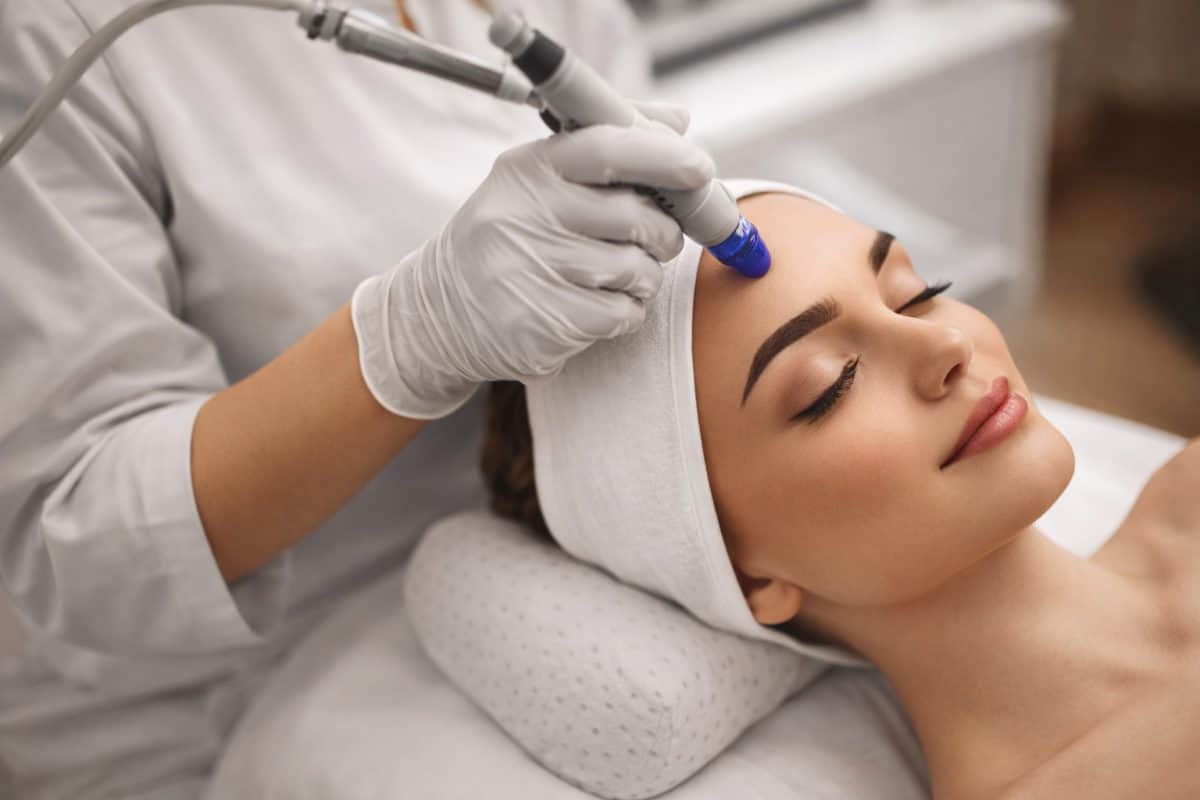
The therapist holds a section of skin taut with one hand and works with the other, blade at roughly forty-five degrees, in short feathering strokes. She moves jaw to cheek to forehead, and stays off the eyelids, the lips, and anywhere the skin will not hold tension. The blade is single-use and surgical grade, opened in front of you.
Twenty to thirty minutes, and most people find it oddly relaxing. It sounds like fine sandpaper and feels like very little.
Two things, and only two. Vellus hair, the fine soft down that covers almost everyone’s face and shows up in raking afternoon light. And the loose upper layer of corneocytes, the flattened dead cells at the top of the stratum corneum that were on their way off anyway.
That is the entire mechanism, and everything dermaplaning does well follows from it. Skin reflects light evenly instead of scattering it across a layer of fuzz, which is why the result reads as glow rather than smoothness. Foundation sits flat instead of catching around hairs, and serums sink in a little faster for a few days.
A genuinely good outcome. Also a strictly surface one.
Pigmentation is the claim that comes up most often and holds up least. Melanin is made further down, in the basal layer, and deposited into cells that take weeks to travel upward. A blade working at the top of the epidermis takes off cells that finished that journey some time ago, so the freckling, the melasma and the marks left by old spots are still there when you sit up.
Scarring is further out of reach again. Depressed acne scars are a dermal problem, collagen architecture well below anything a surface treatment touches, and the same goes for lines that come from structural change rather than dryness.
A skin condition, as opposed to a skin preference, is a conversation for a doctor first.
Around day three you run a hand along your jaw, feel bristle where there was down, and reach the obvious conclusion. Everyone does this.
What changed is the end of the hair, not the hair. Vellus hair grows to a fine tapered point, so what your fingertips normally meet is the thinnest part of it. A blade cuts straight across the shaft and leaves a blunt end, the full width presented flat against your hand. Coarser to touch, identical under a microscope.
Same diameter, same colour, same number as there were on Tuesday. Give it a fortnight and the cut end wears down and softens again.
For facial hair to genuinely become thicker or darker, the follicle would have to switch what it produces – vellus hair converting to terminal hair, a hormonal event driven largely by androgens. It happens at puberty, and to some women with PCOS or through the shift around menopause.
Nothing occurring on the surface causes it. The follicle sits well down in the dermis with its own blood supply; a blade held against the stratum corneum is working a fraction of a millimetre from the outside air.
One caveat, because it is where the myth gets its oxygen. If you already have terminal hairs on the chin, dermaplaning cuts those too, and that regrowth does feel coarse – because those hairs were coarse already.
Both cut hair off at skin level, neither touches the follicle, and neither changes how fast it comes back.
The difference is geometry. A cartridge razor rides on a guard bar that holds the blade off the skin, and it is built for wet use on a layer of foam whose whole job is to stop the blade catching. A dermaplaning blade is flat, unguarded, and held at a shallow angle against dry, taut skin. Nothing sits between the edge and the corneocytes, and that contact is what turns a hair-removal tool into an exfoliation tool.
So no, shaving your face with foam is not a cheap dermaplane – it takes the hair and leaves the dead cells where they were.
The tools are easy to find here and cost almost nothing – the little Japanese-style eyebrow razors run five to ten dollars in most pharmacies, and the guarded wands sold online sit under thirty. For removing vellus hair so foundation stops catching, they work.
What they will not replicate is the exfoliation, and that is by design: the guard that makes a home tool safe for an untrained hand also holds the edge off the skin. A few rules keep it useful rather than damaging:
– Clean, completely dry skin, every time
– A fresh blade every two or three uses
– Never over an active spot or anything raised
– Stop the moment the blade drags rather than glides
– No acids or retinoids that night
The rule is simple enough to apply in your own mirror: if the skin is raised, inflamed or broken, this is the wrong week for it.
– Pustular or cystic acne. A blade drags bacteria from one lesion across the follicles in its path.
– Rosacea mid-flare. Friction on skin whose problem is reactivity rarely ends well.
– Eczema and dermatitis, where the barrier is already failing.
– Sunburn, or skin that peeled in the past week.
– An active cold sore, since herpes simplex travels across the face on the blade.
– Any wound, graze or healing scab, however small.
A therapist worth booking will look at your skin and tell you to come back in a fortnight. If nobody checks before the blade comes out, that is information about the salon.
The group that gets caught out is not the one with obvious inflammation. It is the woman whose skin looks perfectly fine and who is already exfoliating twice a week without thinking of it that way.
A prescription retinoid, a glycolic toner most evenings, a peel three weeks ago – any of these means the stratum corneum you bring to the appointment is thinner than the treatment assumes. Take more off and you get the tight, shiny, stings-when-you-apply-anything result people mistake for sensitivity. Pause the actives three to five days either side and the same appointment is uneventful.
If your skin has turned reactive and you cannot say why, that is a question for a dermatologist.
Salons set their own pricing, so treat these as ranges you will commonly see, not a quote.
In most main-centre salons a standalone dermaplane runs somewhere around seventy to a hundred and twenty dollars for a half-hour appointment. Added onto a facial you are already booked in for, it commonly costs thirty to fifty on top, which is the best value of the three. A combined treatment, dermaplaning then an enzyme mask or LED, typically lands between a hundred and fifty and two hundred and twenty.
What the higher price buys is almost never a better blade. It is the therapist’s hours and whatever gets layered on afterwards.
Four to six weeks is the honest answer, and it comes straight from turnover. A full epidermal cycle takes around a month in your thirties and slows from there, so going back at two weeks means removing cells the skin has not finished making. Do that repeatedly and you get the same thinned, reactive result as over-using acids, at greater expense.
The best use of it is not maintenance at all. Book it four or five days before something you are being photographed at, which leaves time for any flushing to settle.
Aftercare is short and deeply unglamorous, which is why it gets ignored. Leave the skin alone.
No acids, no retinoids, no scrubs and no clay masks for three to five days. Cleanse gently, moisturise, and that is the routine – the temptation to layer on the good serums while everything absorbs so well is worth resisting.
Sunscreen is the part people skip and the part that matters most here. You have just taken off the top layer of dead cells and the fine hair over it, on skin about to walk into New Zealand UV that runs materially higher than the northern hemisphere at the same latitude. Broad-spectrum SPF50 every morning for a week.
Flushing for a few hours is normal. Stinging still there the next day is not.
Dermaplaning is a good treatment carrying bad marketing. As surface exfoliation with a hair-removal bonus it is quick, immediate and pleasant, and there is nothing wrong with booking it for exactly that. The salons doing the best work tend to be the ones willing to tell you what it will not do before you get on the bed.