Ingredients, reviews, and professional insight for NZ beauty
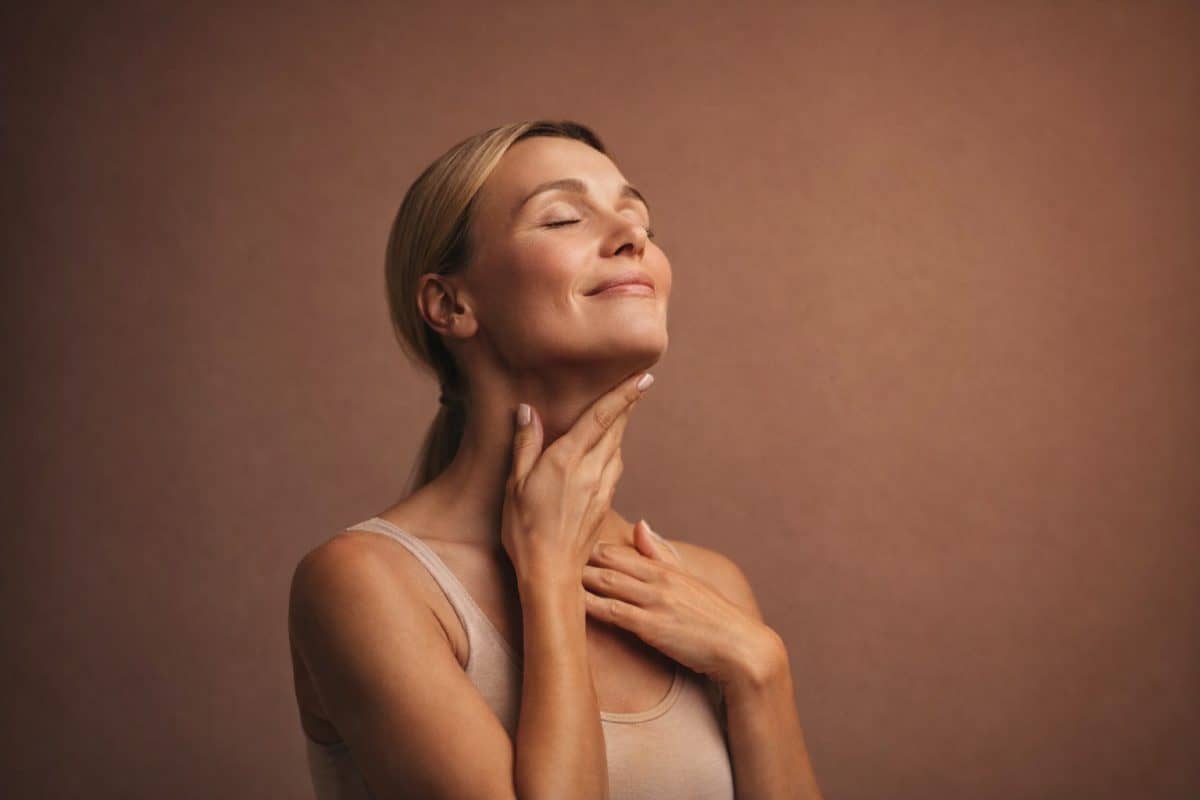
Most skincare routines stop at the jawline, which is roughly where the evidence of them stops too. The neck, chest and backs of the hands take the same New Zealand UV as the face, get a fraction of the attention, and have considerably less structural margin to absorb the damage. Here is what is actually going on down there, and what is worth doing about it.
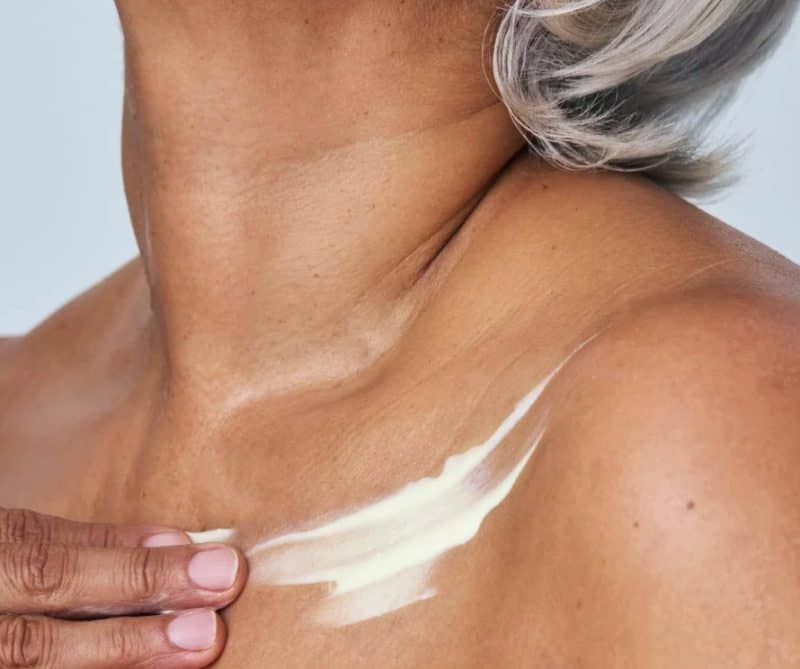
The skin on your neck is noticeably thinner than the skin on your cheeks, and the chest is not much better. Both have fewer sebaceous glands – the oil-producing glands that keep facial skin supple and give it a natural lipid layer to sit behind. Less oil means less defence against water loss, which is why the neck creases and the chest crepes while the face is still holding together.
The backs of the hands are the extreme version. Almost no subcutaneous fat, very little oil, and skin thin enough that you can watch the tendons work. Add the fact that they get washed several times a day, every day, and the maths stops being surprising.
Then there is the sun, and New Zealand does not go easy on anyone. Peak UV here runs well above comparable latitudes in Europe, and the surfaces catching it are the ones nobody thinks about: the triangle of chest exposed by every scoop-neck top, the back of the neck under a ponytail, and the hands on the steering wheel through a windscreen that blocks UVB but lets plenty of UVA through.
None of that registers as sun exposure. Nobody puts sunscreen on to drive to Pak’nSave. But it accumulates on the skin least equipped to repair it, which is why SunSmart’s New Zealand guidance treats incidental hours as seriously as a day at the beach.

Watch anyone apply SPF and you will see the same stopping point: a clean line at the jaw, occasionally a swipe down the throat if they are being thorough. The skin below that line does the same job with none of the equipment.
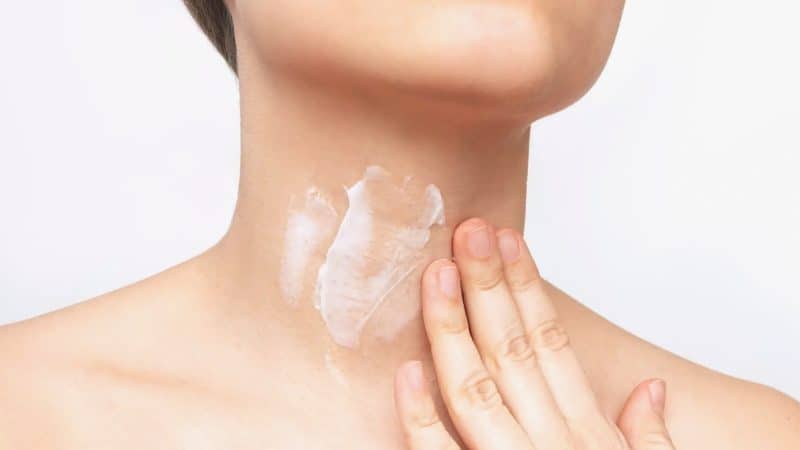
Extending the habit costs about ten seconds. Take whatever you already use on your face down past the jaw, over the sides and back of the neck, and across the collarbones and upper chest. Then do the backs of the hands. If your facial sunscreen is expensive enough that this feels wasteful, use a body SPF below the jaw and keep the good one for your face – the filters are doing the same work either way.
Hands are the part that defeats people, understandably. Sunscreen on the backs of the hands survives roughly until the next time you wash them, which on most days is within the hour.
The fix is not discipline, it is placement. A tube by the kitchen sink, one in the car door, one in the bag you actually carry. If it is within reach of the tap you might use it; if it is upstairs in the bathroom you will not.
Some hand creams now carry SPF, which solves both problems at once, though the protection factor is often modest and most people apply less than the tested quantity. Treat it as a useful habit rather than full coverage.
The actives that do useful work on the face mostly work lower down too, with adjustments. Retinoids improve texture and support collagen production, but neck and chest skin is thinner and more reactive, so go slower than you would on the face – twice a week over a moisturiser, and stop if it turns angry.
Niacinamide is the easy one: it supports barrier function, helps with uneven tone, and is well tolerated almost everywhere. Vitamin C earns its place on the chest and hands, where pigment tends to gather, though evidence supports gradual softening rather than removal.
An AHA body lotion – lactic or glycolic – handles the sandpapery texture that turns up on the upper arms and chest. Results vary, and they arrive over months rather than weeks.
It is worth being clear about the ceiling. Creams work on the surface and the upper layers; they do not restore lost elastin or tighten skin that has genuinely slackened. The horizontal neck lines that come from a lifetime of looking down at things are structural, and no serum sold in a pharmacy is going to unpick them.
Pigmentation is the same story with a softer edge. Sustained use of vitamin C, niacinamide or an AHA can fade the look of sun-related marks on the hands over months, and consistent SPF reduces further UV damage. Existing damage is managed, not undone.
One practical note: any spot that changes shape, colour or size is a job for your GP, not a moisturiser. New Zealand’s melanoma rates make that worth saying plainly.
Here is where the budget conversation starts. A 30ml facial serum covers your face for two or three months. The neck, chest and hands need several times that quantity, and applying a $120 serum at that rate is not a plan anyone sustains past the second bottle.
Buy face-sized products for the face and body-sized products for everything below it. NZ pharmacies and Farmers stock body lotions with real concentrations of urea, lactic acid, glycerin and niacinamide in 400ml bottles, usually somewhere between $20 and $45. CeraVe, QV and Nivea all sit in that space.
The formulas are less elegant than a facial serum and the textures are heavier. For the amount of skin involved, that is the correct trade.
None of this survives contact with a real morning unless it is easy. The version that works for most people is short: sunscreen down to the collarbones and over the hands in the morning, a body lotion at night while the skin is still slightly damp from the shower, and whatever active you are using two or three nights a week on the neck and chest.
Texture matters more here than it should. In Auckland humidity a heavy occlusive – a product that seals water in by sitting on the surface rather than sinking in – feels unbearable in February, so a lighter lotion in summer and something richer in winter is a reasonable swap. Canterbury and Central Otago have the opposite problem, dry enough year-round that the richer option makes sense most months.
The neck, chest and hands are not really a separate skincare category. They are skin that got left off the list. Almost nothing here calls for new products or a longer routine – it calls for the routine you already have to travel about twenty centimetres further down.