Ingredients, reviews, and professional insight for NZ beauty
Somewhere around 2015, the skincare internet decided that niacinamide and vitamin C were mortal enemies. The rule spread with the confidence of established science and the rigour of a WhatsApp forward. A decade later, cosmetic chemists are still correcting it, and products containing both ingredients are sitting on shelves at Farmers.
The claim traces back to research published decades ago on the interaction between ascorbic acid and nicotinic acid — not niacinamide, which is a different form of vitamin B3 entirely. Under specific laboratory conditions (pH below 3.5, high concentrations of both ingredients, elevated temperatures), ascorbic acid could convert nicotinic acid into a compound called nicotinic acid-ascorbic acid complex. The result was a loss of efficacy for both ingredients and, in some cases, flushing from the nicotinic acid byproduct.
The problem is that those conditions bear almost no resemblance to what happens on your bathroom shelf. The study used concentrations and pH levels that no modern skincare product would replicate. But the finding entered the beauty knowledge base as a flat rule — “vitamin C and niacinamide cancel each other out” — and stayed there, stripped of every qualifier that made the original research meaningful.
By the mid-2010s, the myth had its own ecosystem. Beauty YouTubers cited it as established fact. Instagram infographics presented it in clean pastel graphics with confident authority. Skincare Reddit threads debated layering order with the intensity of people defusing a bomb. Each retelling stripped away another layer of context until a conditional laboratory observation became an absolute consumer commandment.
What dermatologists and cosmetic chemists actually said — that the interaction was theoretically possible but practically irrelevant in modern formulations — never made it into the content cycle. Nuance does not perform well on social media. “These two ingredients are fine together for most people in most products” is not a headline anyone clicks on. “NEVER mix these ingredients” is. And so the myth perpetuated itself, fuelled by the same engagement mechanics that sell detox teas and jade rollers.
The flushing concern deserves its own correction because it is the most persistent part of the myth. Nicotinic acid — also called niacin — does cause vasodilation and facial flushing. That is a real and well-documented reaction. But nicotinic acid and niacinamide are not the same ingredient, despite both being forms of vitamin B3.
Niacinamide (nicotinamide) is the form used in virtually every skincare product on the market, precisely because it does not cause flushing. When someone tells you that combining niacinamide with vitamin C will make your face flush, they are confusing two different molecules. It is a bit like warning someone that sparkling water will get them drunk because it contains water, and so does vodka. The chemical relationship exists, but the functional difference is the entire point.

The theoretical concern involves a pH-dependent reaction. L-ascorbic acid, the most potent and commonly used form of vitamin C in serums, is effective at a pH between 2.5 and 3.5. Niacinamide is stable across a wide pH range. The proposed problem is that at very low pH, ascorbic acid could hypothetically convert a small amount of niacinamide into nicotinic acid.
In practice, this conversion requires sustained exposure at high temperatures — conditions you would find in a poorly stored product over months, not on your face over thirty seconds. At the concentrations used in consumer skincare (typically 10-20% vitamin C and 2-5% niacinamide), and at the temperatures your skin operates at, the reaction is negligible. Several published studies have measured the interaction under real-world conditions and found no meaningful reduction in efficacy for either ingredient.
If niacinamide and vitamin C genuinely could not coexist in a formula, a significant number of products on the market would not work. The Ordinary sells a niacinamide serum that many people layer with their ascorbic acid products. Paula’s Choice formulates products containing both ingredients in the same bottle. So do several professional skincare lines available through NZ clinics.
Cosmetic chemists formulate around pH sensitivity as a matter of routine. They buffer acids, stabilise active ingredients, and test for interactions before a product reaches the shelf. The notion that consumers need to solve a formulation problem that professionals addressed years ago gives the skincare internet more credit than it deserves. The industry moved on. It built products that contain both ingredients, tested them, and sold them. The Reddit threads just never got the memo.
Vitamin C — specifically L-ascorbic acid — is one of the most studied antioxidants in skincare for good reason. It neutralises free radicals generated by UV exposure, which is why a morning application before sunscreen makes practical sense. In a country with UV index readings that regularly exceed what most Northern Hemisphere skincare advice accounts for, that antioxidant layer is not a nice-to-have.
Beyond UV defence, ascorbic acid inhibits tyrosinase, the enzyme responsible for melanin production. This is the mechanism behind its brightening effect — it is not bleaching skin, it is interrupting the process that produces excess pigment in response to sun exposure. It also plays a role in collagen synthesis, supporting the structural protein that keeps skin firm. These are not marketing claims. They are well-documented biochemical functions that operate at the cellular level, provided the vitamin C is in a stable, bioavailable form and at an effective concentration.
Niacinamide is the ingredient that does six things competently rather than one thing brilliantly, which is exactly why it belongs in most routines. It strengthens the skin barrier by supporting ceramide production — the lipids that hold skin cells together and prevent moisture loss. It reduces transepidermal water loss, calms inflammation, and regulates sebum production without stripping oil.
For anyone using a vitamin C serum, niacinamide is a particularly logical companion. L-ascorbic acid is an acid, and while it delivers real benefits, it can temporarily compromise barrier function in sensitive skin. Niacinamide shores up exactly what vitamin C might briefly challenge. They are not working against each other; they are addressing different aspects of skin health through different mechanisms. One is an antioxidant and brightener. The other is a barrier builder and anti-inflammatory. The idea that you would choose between them is like deciding whether your car needs an engine or wheels.
Hyperpigmentation is one area where using both ingredients together produces genuinely better results than either alone. They attack the problem from different ends of the same process. Vitamin C inhibits tyrosinase, reducing the production of melanin in the first place. Niacinamide works further down the chain — it interferes with the transfer of melanin from melanocytes (the cells that produce pigment) to keratinocytes (the skin cells you actually see).
For NZ women dealing with sun spots, post-inflammatory pigmentation, or the general unevenness that accumulates from years of high UV exposure, this dual approach is more effective than relying on one ingredient alone. The vitamin C slows production. The niacinamide limits distribution. The result is a more even-toned complexion addressed from two directions rather than one.
Apply your vitamin C serum first. It has the lower pH and typically the thinner consistency, so it goes onto clean skin before anything else in the morning. Wait about sixty seconds for it to absorb — you do not need to time it precisely, just let it settle — then apply your niacinamide product on top. Follow with moisturiser and sunscreen.
If you use a product that contains both ingredients already, the question answers itself. Apply it according to the product directions. The formulator has already handled the pH balancing and concentration ratios. You do not need to second-guess a chemist who has tested the formula for stability.
Morning application is ideal because you get the antioxidant protection from vitamin C working under your sunscreen throughout the day, and the niacinamide supports your barrier against environmental exposure.
There is one scenario where separating your niacinamide and vitamin C into different parts of the day makes sense, and it has nothing to do with them being incompatible. If you have genuinely reactive skin — the kind that flares with multiple actives layered at once — reducing the number of potent ingredients in any single application can help.
A high-concentration L-ascorbic acid serum (15-20%) is already demanding on sensitive skin. Adding niacinamide, retinol, and acids on top of it in the same routine is a lot of active ingredients asking your skin to process them simultaneously. In that case, using vitamin C in the morning and niacinamide in the evening is a practical way to space out your actives. But the reason is skin tolerance, not ingredient chemistry. You are managing your skin’s capacity for stimulation, not preventing a chemical reaction.
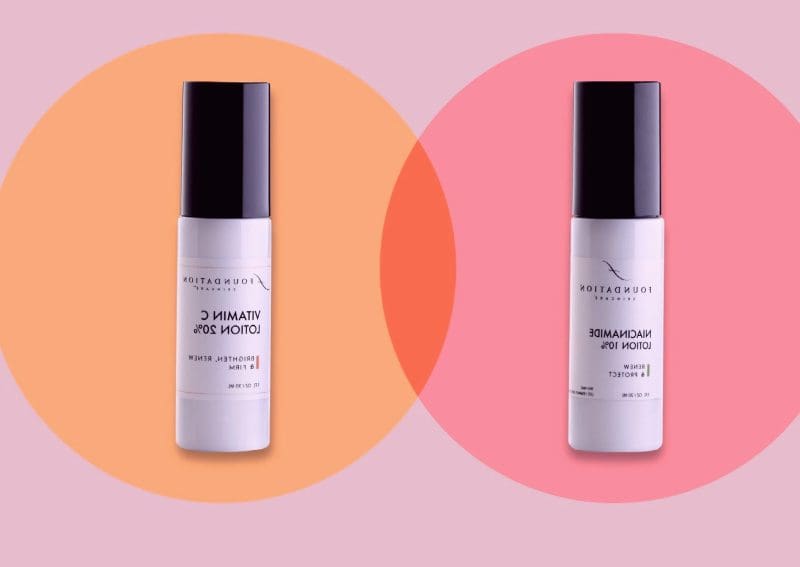
The Ordinary is the most accessible option for both ingredients in New Zealand. Their Niacinamide 10% + Zinc 1% serum and various vitamin C formulations are stocked at Farmers and available online through multiple NZ retailers. Paula’s Choice ships directly to New Zealand and formulates several products containing both ingredients.
For NZ-made options, Antipodes uses vitamin C derivatives in several of their serums, and Trilogy incorporates niacinamide into some of their newer formulations. At the professional end, brands like Aspect, Cosmedix, and Medik8 are available through skin clinics across the country and offer higher-concentration vitamin C serums with proven stability. These clinic-grade products cost more, but they also tend to use more stable vitamin C derivatives and higher active concentrations than what you will find on a pharmacy shelf.
Flip the product over. The ingredient list on the back tells you more than the claims on the front ever will. For vitamin C, look for the specific form:
– Ascorbic acid (L-ascorbic acid) is the most researched and potent but also the least stable
– Ascorbyl glucoside and sodium ascorbyl phosphate are derivatives that trade some potency for better stability and gentleness
– Ascorbyl tetraisopalmitate is oil-soluble and gentler still
The pH and stability concerns that fuel the niacinamide myth apply primarily to L-ascorbic acid — if your product uses a derivative, the interaction is even less relevant.
For niacinamide, check the concentration. The research supporting its skin benefits is built on concentrations of 2-5%. Some products market themselves at 10%, which is not harmful but is not necessarily more effective — and in some people, higher concentrations can cause mild irritation. If your niacinamide product lists it in the first five ingredients, you are likely getting an effective dose. The goal is ingredient literacy: understand what is in your product so you can make decisions based on what it contains, not what the label promises.
The niacinamide-vitamin C conflict was never really about chemistry. It was about a laboratory observation losing its context, one retelling at a time, until a conditional finding became an unconditional rule. Your skin does not care about the debate. It will use both ingredients quite happily if you let it.